Deconstructing Blackstone: A Supreme Constitution, Popular Sovereignty, and Checks & Balances Replace the Old World Order
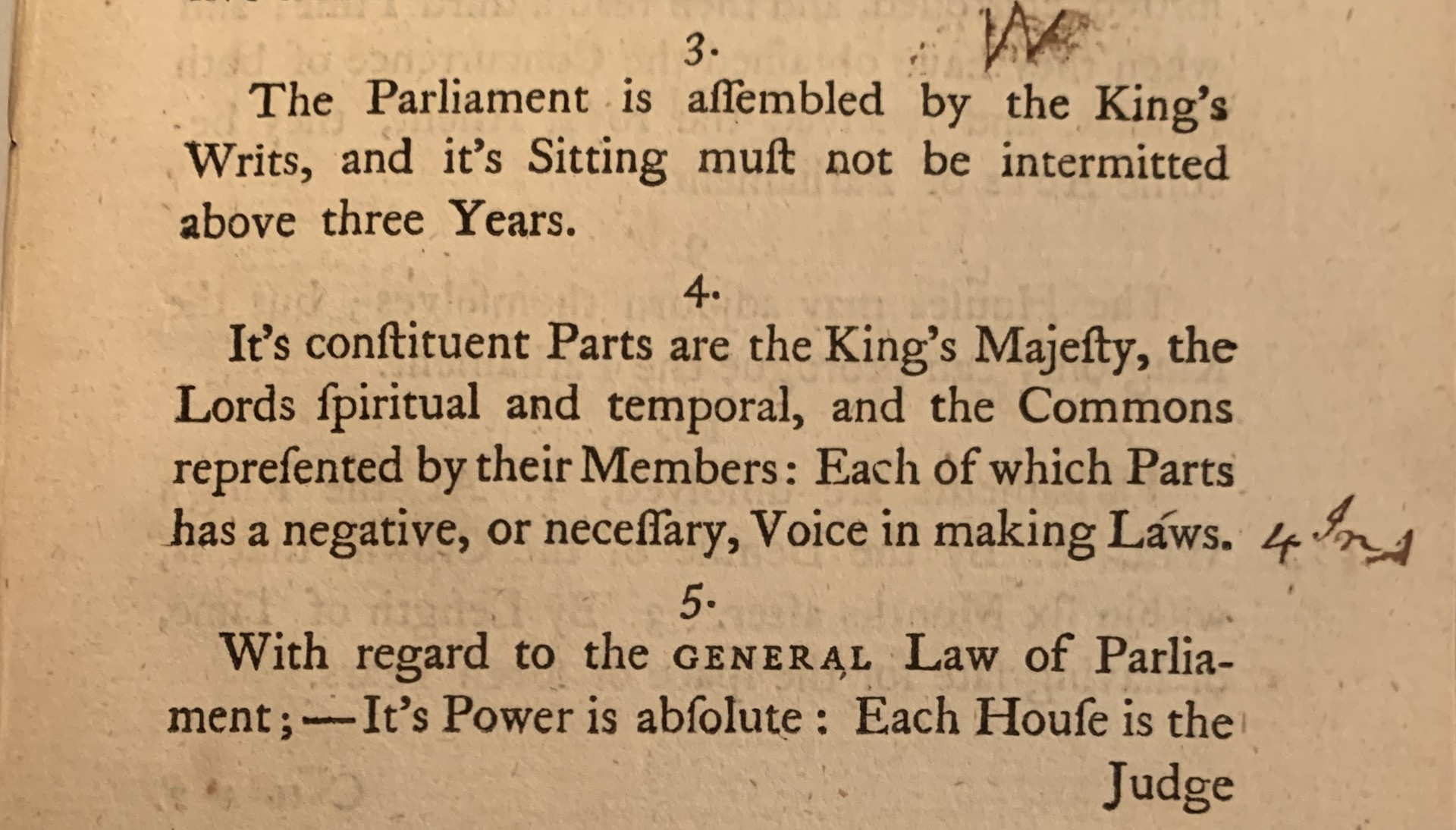
What had begun as a limited revision of government soon became a revolution in government. A sweeping restructuring of the entire civic order was spearheaded by James Wilson, using Blackstone’s British legal framework as a foil. The two notations in the accompanying photograph are some of the earliest artifacts of the creation of the new American constitutional order.
The sawtooth mark at the top of the photograph is Wilson’s personal shorthand for "the People", repeatedly inserted at key places in Blackstone’s text. The dashed line descending from the sawtooth mark is Wilson’s assertion that the People—not a king—should call a nation’s legislature to power.
The second paragraph is Blackstone’s outline of Britain’s ostensible balance of powers. Next to this paragraph, Wilson pointedly wrote "4 Ins" (Coke’s Fourth Institute of the Law). Coke’s Fourth Institute made it perfectly clear that Parliament had, in fact, subsumed the powers of the British monarchy and judiciary, forming an unchecked sovereign power known as the King-in-Parliament. A steady stream of oppressive legislative Acts of Parliament were the primary cause of the recently concluded Revolutionary War. Legislative tyranny was foremost in the Founders’ minds.
To prevent domestic legislative tyranny, balance the new government’s powers, and promote popular sovereignty, a revolutionary redistribution of powers would be adopted by the Convention, featuring:
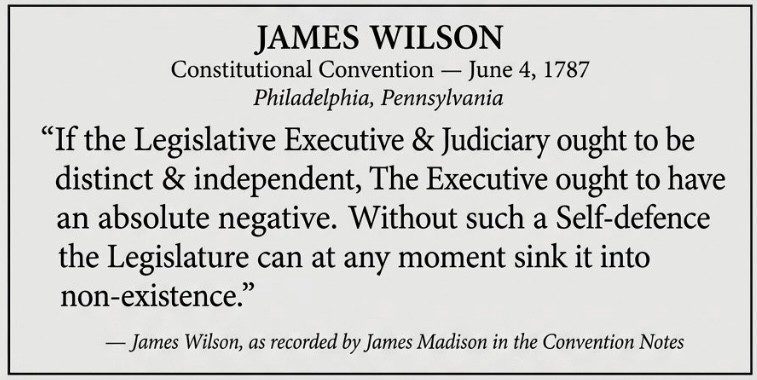
1. The Constitution was elevated above the government as the supreme law of the land—a landmark in the lineage of Magna Carta. 2. The President was vested with veto power, but was subject to a two-thirds congressional override, thus prioritizing the people’s will via their representatives.
3. A supreme national judiciary was adopted with carefully defined powers that were the framework for judicial review, assuring constitutional supremacy in all lawmaking.
Centuries of conflict and hard-won human progress informed the Convention delegates as they crafted a whole new societal order. This new balance of liberty and authority would play out dynamically in a nation whose great expansion had already begun.
Next: A Constitution for Thirteen States and States Yet to Come